It is finally here. After 13 long years of waiting, the most anticipated entertainment product in modern history — Grand Theft Auto VI — has officially launched worldwide on November 19, 2026. Early reviews are calling it an unprecedented technical masterpiece. Workplaces and college campuses across Mumbai, Pune, Bengaluru, and Delhi are already bracing for widespread sick leaves and midnight absenteeism. Millions of excited gamers are settling in front of their 4K monitors and consoles, ready to immerse themselves in the neon-soaked paradise of Vice City and the state of Leonida alongside protagonists Jason and Lucia.
Yet amidst the launch-day euphoria, sports physicians, orthopaedic surgeons, and ophthalmologists at Sanjivani Hospital are issuing an urgent public health reminder: your body was not built to sit motionless in a chair, muscles locked, eyes unblinking, and wrists compressed for 8, 12, or 16 hours straight. Prolonged, unbroken gaming marathons trigger severe physiological strains that go far beyond temporary muscle stiffness.
India is currently the second-largest digital gaming market globally, boasting over 560 million active gamers. Cross-sectional health surveys reveal that 75% to 80% of urban Indian adults aged 18–30 game regularly, with over 35% playing for 3 or more hours daily. Even more critically, parental surveys in metropolitan centres indicate that nearly 1 in 2 school-aged youths log 3+ hours of daily screen gaming, with intensive brackets exceeding 6 hours. GTA 6's monumental launch will push continuous screen sessions to all-time highs. This guide gives you the definitive clinical playbook to protect your spine, vision, vascular health, and mental well-being while enjoying the game.
The 10 Biggest Health Risks of Marathon Gaming Sessions
Understanding the exact biological mechanisms behind gaming strain allows you to spot warning signs early and intervene before permanent musculoskeletal or neurological damage occurs:
1. 'Text Neck' & Severe Cervical Spine Strain
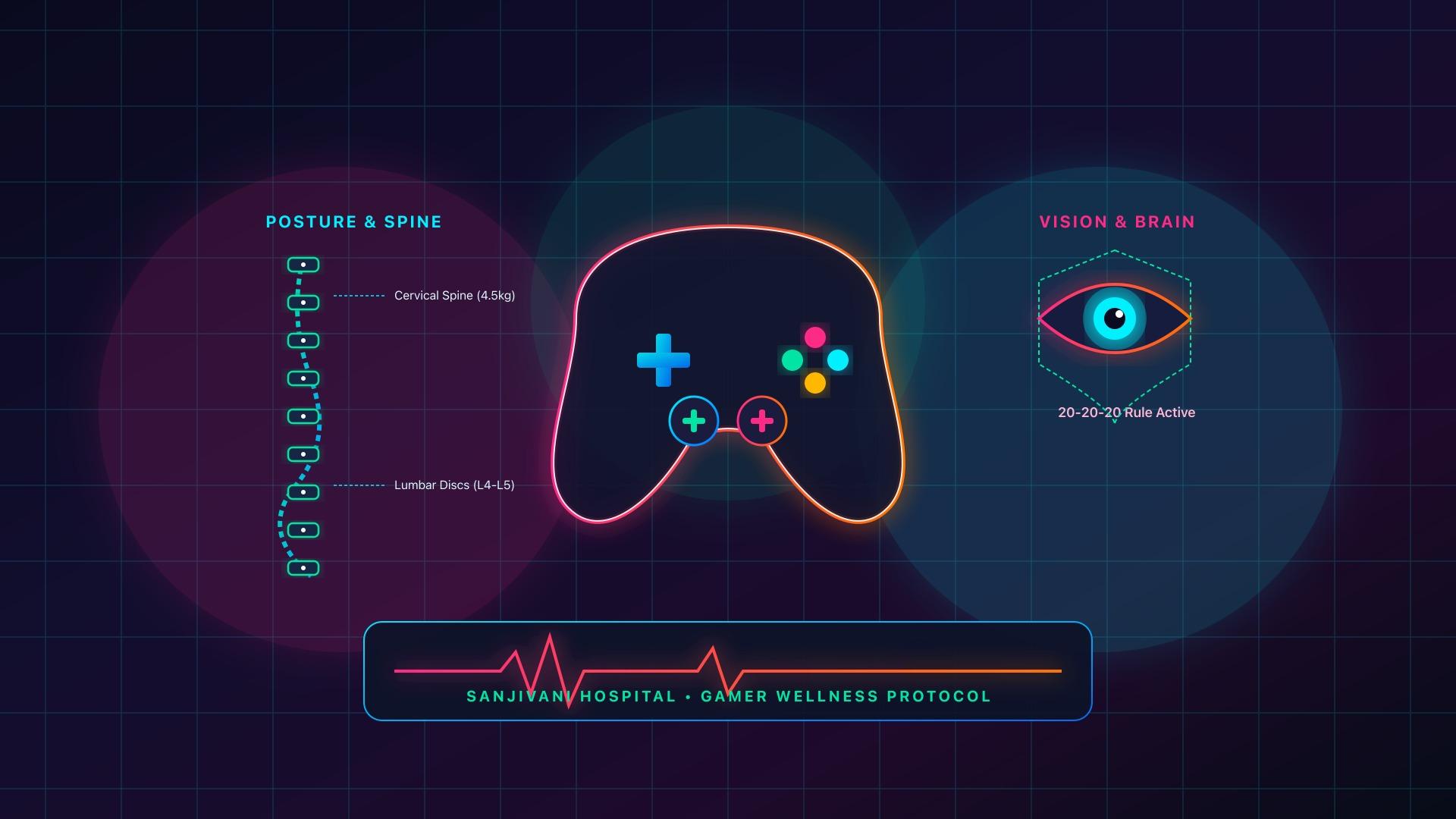
In a neutral, upright position, the average human head weighs roughly 4.5 to 5.5 kg. For every 15 degrees that your head tilts forward to focus on a screen, the effective gravitational load exerted on your cervical vertebrae multiplies. At a typical 45-degree forward gaming lean — commonly called the 'gamer hunch' — your neck muscles, ligaments, and cervical discs (C4–C7) must support an astounding 22 to 27 kg of continuous load. Over multiple hours, this causes severe spasm of the trapezius and levator scapulae muscles, accelerates premature disc dehydration, and triggers cervicogenic tension headaches radiating from the base of the skull.
2. Lumbar Disc Compression & Sciatica
Sitting slouched unsupported in an office chair or soft sofa places up to 140% to 190% more compressive force on your lumbar discs (L4–L5 and L5–S1) compared to standing upright. Without an ergonomic lumbar cushion, the natural inward arch of your lower spine (lordosis) reverses into a dangerous C-curve (kyphosis). When held for hours, this posterior disc displacement can pinch the sciatic nerve root, producing sciatica — sharp shooting pain, numbness, or tingling sensations that travel down the buttocks, hamstrings, and calves.
3. Computer Vision Syndrome (Digital Eye Strain)
Normally, healthy individuals blink approximately 15 to 20 times per minute, constantly refreshing the precorneal tear film that lubricates and protects the eye. Clinical ophthalmology studies confirm that during high-intensity gaming, blink frequency drops by up to 75% (to just 3 to 5 blinks per minute). Staring at fast-moving, high-contrast HDR displays in dark rooms evaporates the tear film, leaving the cornea exposed to micro-abrasions. This results in Computer Vision Syndrome (CVS) — characterised by burning, gritty red eyes, light sensitivity (photophobia), blurred vision, and difficulty refocusing on distant objects.
4. Carpal Tunnel Syndrome & 'Gamer's Thumb'
Rapid, high-frequency button pressing and continuous joystick manipulation place immense repetitive friction on the flexor tendons of the hand and wrist. Sustained wrist extension or resting wrists on hard desk edges compresses the median nerve inside the carpal tunnel, causing Carpal Tunnel Syndrome (CTS) — marked by numbness, tingling, and weakness in the thumb, index, and middle fingers. Additionally, excessive thumb movement causes De Quervain's tenosynovitis ('Gamer's Thumb'), an agonizing inflammation of the tendon sheaths at the radial base of the thumb.
5. Deep Vein Thrombosis (DVT) — The Silent Vascular Threat
Perhaps the most critical medical danger of marathon gaming is Deep Vein Thrombosis (DVT). When your legs remain static for hours in a seated posture, venous blood pooling in the deep calf veins slows circulation to a near-standstill (venous stasis). Under conditions of mild dehydration and prolonged immobility, microscopic blood clots can form in the deep veins. If a clot breaks loose, it travels through the vena cava into the heart and lodges in the pulmonary arteries — causing a Pulmonary Embolism (PE), an acute medical emergency that can be fatal within minutes.
🚨 CRITICAL MEDICAL EMERGENCY WARNING: If during or immediately following a long gaming session you experience unilateral calf swelling, tenderness, warmth or redness in one leg, accompanied by sudden shortness of breath, sharp chest pain when inhaling, or unexplained lightheadedness, STOP GAMING IMMEDIATELY. Call emergency medical services or proceed directly to Sanjivani Hospital's Emergency Department. Pulmonary embolism is a time-critical life threat.
6. Sleep Disruption & Circadian Melatonin Suppression
GTA 6's hyper-vibrant visual palette delivers intense short-wavelength blue light (450–480 nm) directly into your retinas. Specialized intrinsically photosensitive retinal ganglion cells (ipRGCs) detect this light and signal the suprachiasmatic nucleus of the brain to completely halt melatonin production. Playing into the early morning hours tricks your brain into believing it is midday, causing severe circadian rhythm disruption, fragmented deep slow-wave sleep, elevated nocturnal cortisol, and chronic daytime cognitive brain fog.
7. Metabolic Slowdown & Visceral Adiposity ('Gamer Belly')
Continuous sitting reduces lipoprotein lipase (LPL) activity in skeletal muscle by up to 90%, virtually shutting down your body's ability to clear circulating triglycerides and glucose from the bloodstream. When paired with late-night high-sodium processed snacks (chips, noodles, sweetened energy drinks), excess caloric energy is converted directly into visceral fat around the liver and abdominal organs, predisposing young gamers to early insulin resistance, non-alcoholic fatty liver disease (MASLD), and dyslipidemia.
8. Clinical Gaming Disorder & Dopaminergic Burnout
The World Health Organization (WHO) has officially classified Gaming Disorder (ICD-11 code 6C51) as an established behavioural addiction. The dynamic reward loops, open-world missions, and social dynamics of high-budget releases like GTA 6 continuously flood the brain's mesolimbic pathway with dopamine. Over days of compulsive play, dopamine receptor down-regulation occurs, leading to irritability, restlessness, emotional blunting, and an inability to experience satisfaction from real-life tasks like academics, physical fitness, or work.
9. Dehydration, Kidney Stress & Electrolyte Imbalance
Gamers frequently ignore basic thirst cues during intense missions, drinking only when severely parched or substituting clean water with hyper-caffeinated, high-sugar sodas and energy drinks. Chronic mild dehydration thickens the blood, concentrates urinary minerals (increasing the lifetime risk of kidney stones), and impairs renal filtration while placing unnecessary strain on healthy kidneys.
10. Noise-Induced Hearing Loss & Tinnitus from Headsets
To fully experience the explosive audio design, engine roars, and atmospheric Vice City radio stations, gamers routinely wear closed-back gaming headsets at volumes exceeding 85 to 95 decibels (dB). Exposure to sound levels above 85 dB for more than 60 to 90 minutes induces permanent mechanical and metabolic damage to the stereocilia (hair cells) within the cochlea. This manifests first as post-gaming ringing or buzzing in the ears (tinnitus) and eventually transitions into irreversible sensorineural high-frequency hearing loss.
Gaming Ergonomics: How to Configure Your Setup
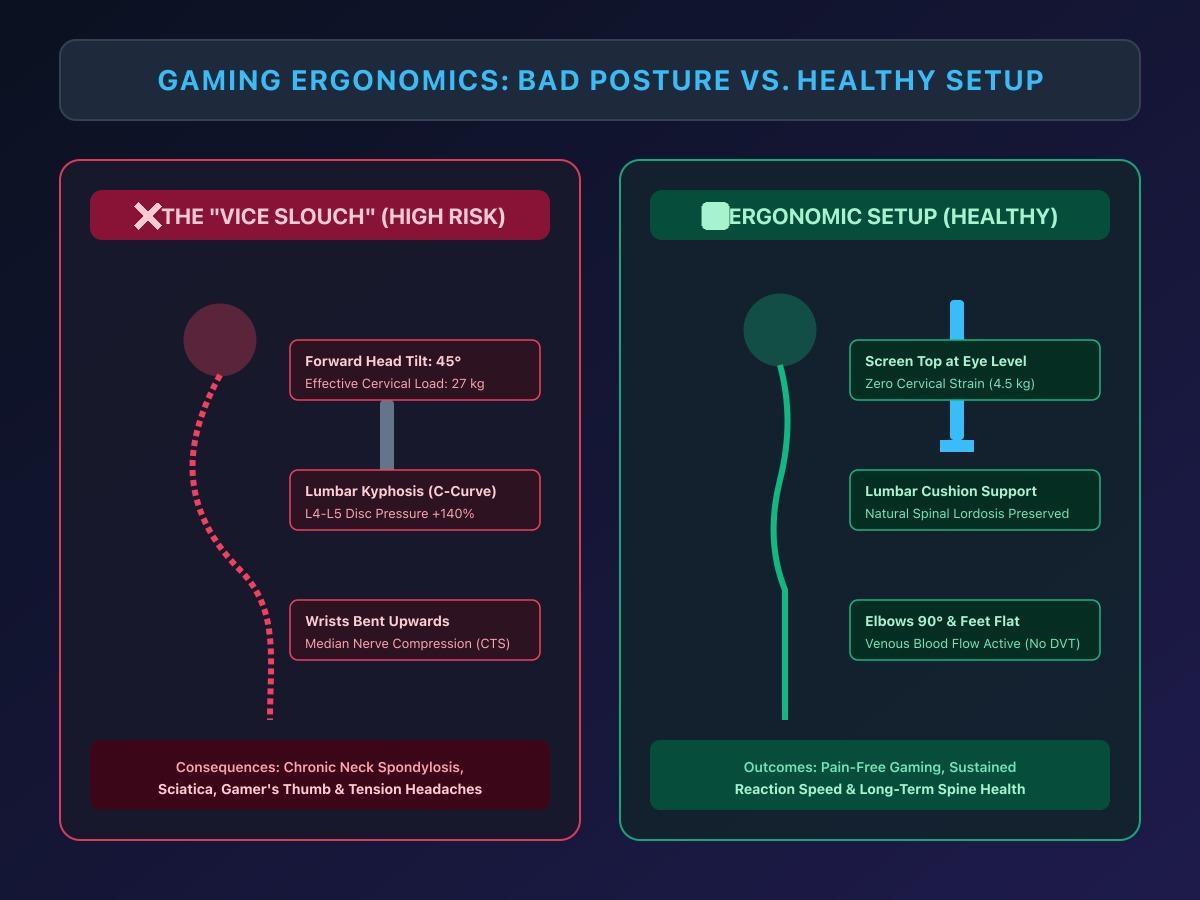
Fixing your posture and screen configuration takes less than 10 minutes and prevents nearly 80% of gaming-related musculoskeletal injuries. Follow this clinical checklist:
Ergonomic configuration checklist for long gaming sessions
Scroll table →| Body Area | Common Bad Setup ❌ | Correct Ergonomic Position ✅ | Clinical Benefit |
|---|---|---|---|
| Neck & Head | Screen placed low, head tilted forward 45° | Top third of display aligned exactly at eye level; chin tucked slightly | Eliminates 22 kg of excess gravitational cervical load; prevents neck spasm |
| Lower Back | Slouching into a C-curve without lower back support | Firm lumbar cushion maintaining natural inward curve; hips at 90°–100° | Decreases intervertebral disc pressure by up to 140%; prevents sciatica |
| Wrists & Forearms | Wrists bent backward resting against hard desk edges | Forearms parallel to floor, elbows at 90°, padded wrist support | Decompresses the carpal tunnel; protects median nerve from impingement |
| Feet & Legs | Legs crossed, tucked under chair, or dangling unsupported | Both feet flat on floor or angled footrest; 2–3 inches behind knees clear | Promotes continuous venous blood return; eliminates risk of calf DVT |
| Room Lighting | Pitch-black room with max screen brightness | Soft ambient backlighting (bias lighting) behind display | Reduces pupillary contrast strain and prevents digital eye exhaustion |
The 4 Pillars of Gamer Health & Recovery
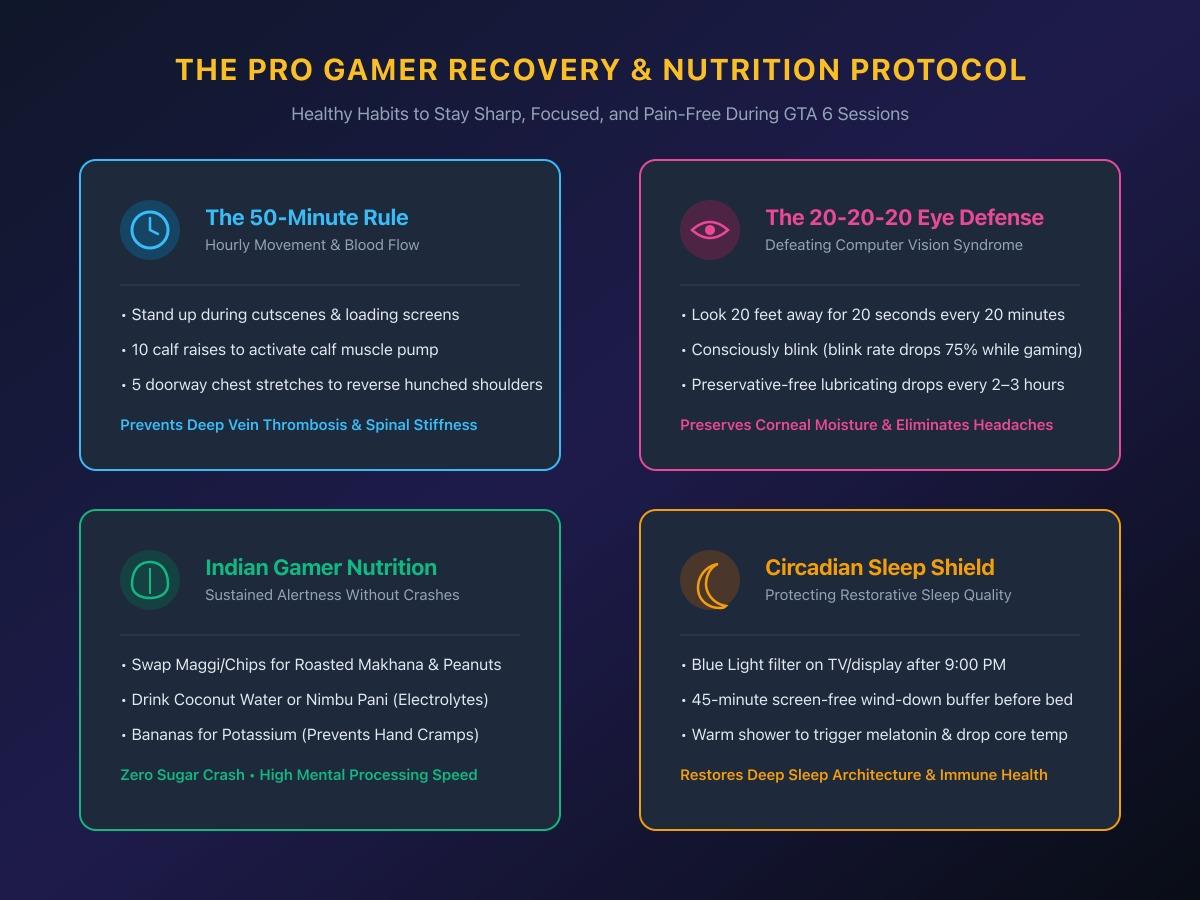
Pillar 1: The Non-Negotiable 50-Minute Break Rule
Set a countdown timer on your phone before starting GTA 6. Every 50 minutes, pause the game or use loading screens and cutscenes to stand up immediately. Perform 2 minutes of active movement: walk around your room, do 15 calf raises (to mechanically activate the calf muscle pump that pushes venous blood back toward the heart), and do 5 gentle doorway chest stretches to reverse rounded shoulders.
Pillar 2: The 20-20-20 Eye Defense System
Endorsed by ophthalmologists worldwide: every 20 minutes, shift your gaze away from the TV or monitor to look at an object at least 20 feet (6 metres) away for a minimum of 20 seconds. This allows the ciliary muscle inside your eye to completely relax from continuous near-accommodation. Concurrently, make a conscious effort to perform 5 complete, firm blinks to redistribute your tear film, and keep preservative-free lubricating eye drops on your desk.
Pillar 3: Smart Indian Nutrition for Sustained Reflexes
High-glycemic junk food causes rapid insulin spikes followed by sharp glucose crashes that destroy reaction times and trigger lethargy. Replace processed snacks with nutrient-dense Indian alternatives that sustain neurotransmitter synthesis and energy levels:
Healthy Indian food swaps for long gaming sessions
Scroll table →| Unhealthy Gamer Snack ❌ | Nutrient-Dense Indian Swap ✅ | Why It Enhances Gaming Performance |
|---|---|---|
| Instant Maggi / Cup Noodles | Vegetable Poha with roasted peanuts or Upma | Slow-digesting complex carbs + plant protein provide steady mental glucose for 3+ hours without an insulin crash. |
| Commercial Potato Chips / Kurkure | Roasted Makhana (fox nuts) with turmeric & pinch of rock salt | Rich in magnesium and antioxidants; supports nerve transmission with 70% fewer empty calories. |
| Sugary Energy Drinks / Colas | Fresh Coconut Water (Nariyal Pani) or Homemade Nimbu Pani | Natural potassium and magnesium balance electrolytes, preventing hand cramps and fatigue without artificial sweeteners. |
| 3 AM Fast-Food Delivery (Pizza/Burgers) | Warm Roti with Green Moong Dal or Egg Bhurji roll | Lean protein stabilizes overnight amino acid balance; avoids heavy saturated fats that induce acid reflux and destroy sleep. |
| Chai with 2–3 spoons of sugar (taken repeatedly) | Unsweetened Green Tea or Black Coffee (before 5:00 PM only) | Delivers clean caffeine and L-theanine for calm, laser-focused reaction time without nocturnal sleep disruption. |
Pillar 4: Circadian Rhythm & Sleep Protection
To safeguard your restorative sleep while enjoying evening gaming sessions: enable the built-in Night Mode / Warm Colour Temperature on your TV or gaming display after 8:30 PM to diminish blue light emission by 40%–50%. Establish a strict 45-minute screen-free transition buffer between turning off your console and climbing into bed. Taking a quick warm shower lowers core body temperature upon exiting, signalling natural sleep readiness to the hypothalamus.
The 5-Minute 'Level-Up' Stretch Routine
Perform this rapid 5-step orthopaedic stretching sequence right at your chair or couch during cutscenes or mission transitions:
5-minute physical therapy stretches for gamers
- Chin Tucks (Cervical Decompression) — Sit tall with shoulders back. Pull your chin straight inward as if making a double chin, holding for 5 seconds. Repeat 10 times to reverse forward head posture and decompress suboccipital nerves.
- Doorway Pectoral Stretch — Place both forearms vertically against a door frame at shoulder height. Step one foot forward and lean in gently until a firm stretch is felt across the chest. Hold for 25 seconds to open collapsed ribcage muscles.
- Seated Spinal Rotations — Cross arms across your chest. Slowly rotate your torso to the right as far as comfortable, holding for 10 seconds, then rotate to the left. Repeat 5 times per side to restore thoracic rotational mobility.
- Wrist Flexor & Extensor Glides — Extend your right arm straight with palm facing forward. Use your left hand to gently pull fingers back for 15 seconds. Then point fingers toward the floor and press the back of the hand. Repeat on the left side to decompress the carpal tunnel.
- Standing Calf Raises & Ankle Pumps — Stand upright and rise onto your tiptoes for 3 seconds, then slowly lower. Perform 20 repetitions to activate the venous muscle pump in the gastrocnemius, preventing DVT.
Mental Health Check: Warning Signs of Gaming Disorder
Open-world sandbox games like GTA 6 are intentionally designed for virtually limitless immersion. While gaming is a legitimate, healthy form of entertainment for the overwhelming majority, it is vital to recognise when recreational gaming crosses into clinical addiction:
Clinical indicators of gaming disorder (ICD-11 criteria)
- Loss of Behavioural Control — Inability to stop playing or limit gaming sessions despite prior intentions (repeatedly telling yourself 'just one more mission' for 4+ hours).
- Displacement of Essential Activities — Giving gaming clear priority over fundamental life needs, such as skipping meals, delaying showers and personal hygiene, missing college lectures, or neglecting work responsibilities.
- Continuation Despite Harm — Persisting with 10+ hour sessions despite severe physical exhaustion, eye pain, relationship breakdowns, or dropping academic grades.
- Deception & Secretive Gaming — Consistently lying to parents, partners, or friends about total hours spent gaming.
- Emotional Withdrawal Symptoms — Extreme irritability, restlessness, anxiety, or depressive mood swings whenever forced to pause or disconnect from the game.
- Using Gaming as Sole Emotional Avoidance — Playing exclusively to escape real-world stress, loneliness, or emotional trauma rather than engaging with solutions.
⚠️ Support for Families & Gamers: If you or a loved one is experiencing compulsive digital dependency, recognise that behavioural addiction is a treatable health condition, not a personal flaw. The Government of India provides free, 24/7 confidential mental health counselling through Tele-MANAS (Dial 14416 or 1800-891-4416). Sanjivani Hospital's Psychiatry & Counselling Department also provides specialized adolescent and adult behavioural evaluations.
When to See a Doctor at Sanjivani Hospital
Do not ignore physical warning signs or assume pain will resolve on its own. Schedule an in-person consultation at Sanjivani Hospital if you notice any of the following symptoms:
Medical symptoms requiring clinical evaluation
- Persistent Neck or Lower Back Pain lasting more than 5 to 7 days that does not ease with rest or basic stretching.
- Tingling, Numbness, or 'Pins and Needles' in the fingers, thumb, or down the leg — indicating nerve compression (CTS or sciatica).
- Chronic Eye Redness, Pain, or Blurry Vision persisting after shutting down displays, indicating possible dry-eye keratopathy.
- Unilateral Leg Swelling, Warmth, or Calf Tenderness — requires urgent evaluation to rule out deep vein thrombosis.
- Persistent Ringing in the Ears (Tinnitus) or muffled hearing following long headphone use.
- Severe Insomnia, Anxiety, or Inability to Disconnect from gaming that is impacting academic, professional, or personal life.
🏥 Comprehensive Orthopaedic, Ophthalmic & Wellness Care at Sanjivani Hospital, Virar: Whether you are dealing with cervical spine stiffness, wrist tendonitis, digital eye strain, or need lifestyle and metabolic counselling, our experienced team of Orthopaedic Surgeons, Physiotherapists, Eye Specialists, and General Physicians is here to help you recover fast. 📞 Appointments & Consultations: +91 9168505029 | Datta Mandir Road, Near Virar Railway Station, Virar West.
The Bottom Line: Enjoy Vice City, Protect Your Reality
Key takeaways for safe marathon gaming
- GTA 6 is a historic cultural event — but your health is irreplaceable. Virtual achievements in Leonida mean nothing if you develop chronic spine pathology or a life-threatening blood clot.
- Enforce the 50-minute rule religiously — stand, walk, hydrate, and activate calf muscle pumps every single hour.
- Protect your eyes with the 20-20-20 rule and conscious blinking in a properly lit room with lubricating drops.
- Fuel your gaming sessions with whole Indian foods like roasted makhana, coconut water, poha, and dal-roti instead of processed sugar and midnight junk deliveries.
- Listen to your body — persistent numbness, chronic pain, or shortness of breath are medical signals, not minor inconveniences. Consult our specialists promptly.