Cardiovascular disease remains the leading cause of mortality in India, accounting for nearly 28% of all deaths. According to the Indian Heart Association, South Asians suffer from heart attacks at a significantly younger age—often 5 to 10 years earlier than Western populations—due to a combination of genetic predisposition, high insulin resistance, elevated Lipoprotein(a), and lifestyle stress.
A heart attack (Myocardial Infarction - MI) occurs when a coronary artery supplying oxygen-rich blood to the cardiac muscle becomes acutely occluded by a blood clot (thrombus) forming over a ruptured cholesterol plaque. When blood flow is cut off, cardiac cells begin to die within 20 to 30 minutes. Recognizing warning signs early and reaching a cardiac-ready emergency room during the 'Golden Hour' is the single most decisive factor in saving lives.
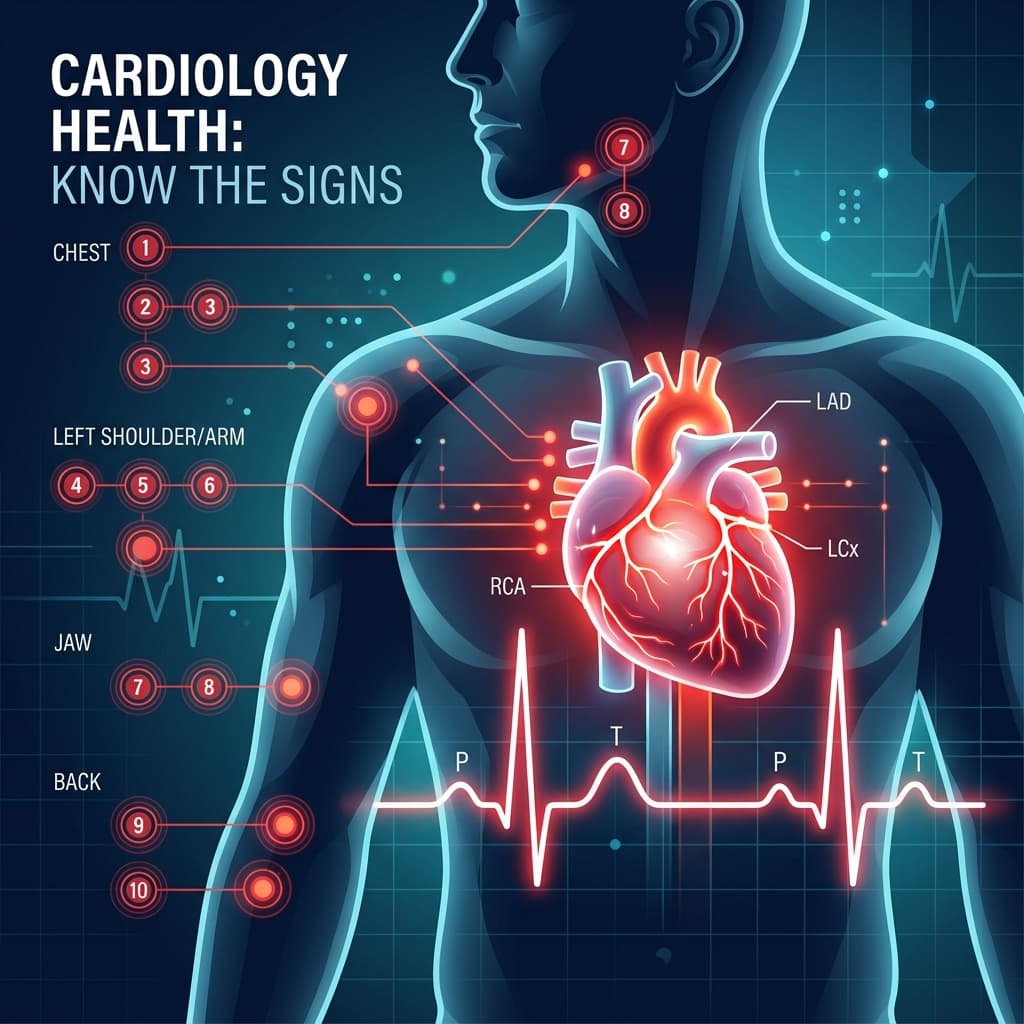
The 10 Warning Signs of a Heart Attack You Should Never Ignore
1. Chest Pressure, Squeezing, or Heavy Pain (Angina)
The most hallmark symptom of a heart attack is discomfort in the center or left side of the chest. Patients frequently describe it as a heavy weight, severe crushing tightness, or an excruciating squeezing sensation ('like an elephant standing on my chest'). In clinical practice, patients often place a clenched fist over their sternum—a classic sign known as Levine's sign. The pain typically lasts more than a few minutes or may go away and return.
2. Pain Radiating to Left Arm, Shoulder, Neck, Back, or Jaw
Cardiac ischemic pain does not always stay confined to the chest. Sensory nerve fibers from the heart enter the spinal cord at the same thoracic segment levels (T1–T5) as nerves originating from the upper limbs, neck, and jaw. This neural crossover causes 'referred pain' that radiates down the left arm, into the shoulder blades, upper back, or along the lower jaw and throat.
3. Sudden Shortness of Breath (Dyspnea)
Feeling acutely short of breath—as if you have just sprinted up several flights of stairs while sitting still—is a cardinal heart attack sign. When a coronary artery is blocked, the failing left ventricle cannot pump blood effectively, causing fluid to back up into the pulmonary blood vessels (pulmonary congestion). Dyspnea can occur before or alongside chest pain, and is often the main symptom in women and elderly patients.
4. Profuse Cold Sweats & Sudden Diaphoresis
Breaking out in a sudden, drenching cold sweat without any physical exertion or high room temperature is a classic autonomic sign of acute cardiac distress. When cardiac tissue experiences severe oxygen deprivation, the body activates a massive sympathetic nervous system ('fight-or-flight') response, flooding the bloodstream with adrenaline and triggering sweat glands.
5. Unusual, Severe Fatigue & Exhaustion (Especially in Women)
Feeling overwhelmed by sudden, unexplainable fatigue—where simple tasks like making a bed or walking across a room feel completely exhausting—can manifest days or weeks before a major cardiac event. Reduced cardiac output lowers oxygen delivery to skeletal muscles throughout the body. Research shows that unexplained fatigue is one of the most common early warning signs reported by female heart attack survivors.
6. Dizziness, Lightheadedness, or Near-Fainting (Presyncope)
Feeling dizzy, unsteady on your feet, or experiencing a sudden room-spinning sensation is a warning sign of compromised cardiac function. An acute myocardial infarction or associated ventricular arrhythmia impairs the heart's ability to maintain adequate blood pressure, leading to transiently reduced blood flow to the brain (cerebral hypoperfusion).
7. Nausea, Indigestion, Heartburn, or Abdominal Discomfort
Heart attack pain is frequently misdiagnosed as severe acidity, GERD, or food poisoning. When an acute blockage occurs in the Right Coronary Artery (RCA)—which supplies the inferior wall of the heart sitting directly above the diaphragm—it irritates the adjacent vagus nerve and gastrointestinal structures, causing severe nausea, vomiting, or a burning stomach sensation.
⚠️ Dangerous Misconception: Taking antacids for 'severe acidity' when experiencing chest tightness or epigastric burning delays critical emergency cardiac care. If stomach burning is accompanied by sweating or breathlessness, treat it as a cardiac emergency.
8. Unexplained Rapid or Irregular Heartbeat (Palpitations)
Feeling your heart pounding against your ribs, skipping beats, racing uncontrollably, or fluttering in your throat can indicate cardiac electrical instability. Ischemia disrupts the normal electrical conduction pathway of the heart, triggering potentially lethal cardiac arrhythmias such as Premature Ventricular Contractions (PVCs) or Ventricular Tachycardia (VT).
9. Sense of Impending Doom or Acute Panic
Many heart attack survivors describe an acute, intense wave of terror or a feeling that 'something catastrophic is happening to my body' right before or during an attack. This psychological reaction is not just mental panic; it is a direct neurochemical response triggered by severe myocardial hypoxemia and massive adrenaline secretion.
10. Swelling in Lower Legs, Ankles, or Feet (Peripheral Edema)
Puffy, swollen ankles and feet (where socks leave deep skin indentations) indicate fluid retention due to impaired heart pumping efficiency. As cardiac output drops, blood pools in the venous system, causing fluid to leak into peripheral tissues. When combined with sudden weight gain or breathing difficulty, leg edema signals significant cardiovascular strain.
Interactive Heart Attack Warning Signs & Golden Hour Explorer
Explore anatomical symptom locations, compare men vs. women warning patterns, examine golden hour timelines, and use our emergency triage checker below.
10 Heart Attack Warning Signs & Golden Hour Interactive Guide
Explore anatomical symptom locations, gender-specific warning patterns, emergency triage protocols, and golden hour windows.
The "Golden Hour" Door-to-Balloon Window
In cardiology, "Time is Muscle". Restoring blood flow to the blocked coronary artery within 60 to 90 minutes prevents permanent scarring of heart muscle.
Symptom Onset & Emergency Call
Recognize chest discomfort / dyspnea. Stop all physical activity immediately. Call Sanjivani ER / 108 emergency hotline.
ER Arrival & 12-Lead ECG Triage
Rapid triage at ER. Continuous 12-lead ECG, blood pressure, oxygenation monitoring, and Troponin I/T blood biomarker draw.
Cath Lab / Angioplasty (Primary PCI)
Door-to-Balloon window. Transfer to Cardiac Cath Lab for immediate balloon angioplasty and stenting to unblock closed coronary artery.
Progressive Myocardial Necrosis
Every minute of delayed blood flow increases permanent heart muscle death. Reperfusion within 60–90 mins preserves cardiac tissue.
Click to Explore All 10 Warning Signs
Chest Pressure, Squeezing, or Heavy Pain (Angina)
Feels like an unbearable crushing weight, severe tightness, or burning in the middle of the chest lasting more than a few minutes, or going away and returning.
Most common symptom in men; present in ~70% of women.
Coronary artery occlusion deprives myocardium of oxygen (ischemia), releasing lactic acid and adenosine that stimulate visceral pain nerve fibers.
Heart Attack Symptoms: Men vs. Women & Diabetics
| Symptom Pattern | Typical Presentation in Men | Presentation in Women | Diabetics & Elderly (Silent Ischemia) |
|---|---|---|---|
| Chest Pain Type | Severe retrosternal crushing pain ("elephant on chest") | Pressure, burning tightness, or subtle aching discomfort | Often NO CHEST PAIN at all (silent myocardial infarction) |
| Radiation Location | Spreads down left arm and shoulder | Spreads to jaw, chin, throat, upper back, or right arm | Vague upper back or shoulder blade stiffness |
| Primary Non-Pain Sign | Profuse cold sweating & drenching perspiration | Sudden extreme exhaustion, shortness of breath, nausea | Unexplained weakness, confusion, or sudden breathing difficulty |
| Underlying Reason | Classic obstructive single/multi-vessel CAD | Higher prevalence of coronary microvascular dysfunction | Cardiac autonomic neuropathy dulling cardiac pain perception |
Heart Attack Emergency Triage Screener
Are you or someone near you experiencing any of these active symptoms?
The 'Golden Hour': Why Every Second Counts
The first 60 minutes following the onset of heart attack symptoms is medically known as the 'Golden Hour'. During this critical window, prompt medical intervention—specifically Primary Percutaneous Coronary Intervention (PCI / Angioplasty) or emergency thrombolysis (clot-dissolving medication)—can reopen the blocked artery, restore blood flow, and salvage endangered heart tissue.
⏱️ Time is Muscle: For every 30-minute delay in unblocking an occluded coronary artery, the risk of permanent heart failure or mortality increases significantly. Never 'wait to see if the pain passes'.
Silent Heart Attacks in Diabetics & Elderly Patients
In patients with long-standing diabetes or advanced age, a heart attack may occur with little to no chest pain—a condition termed Silent Ischemia or Silent Myocardial Infarction. Chronic high blood sugar damages autonomic nerve fibers (cardiac autonomic neuropathy), dulling pain signals sent to the brain. In these individuals, a heart attack may present solely as unexplained weakness, sudden confusion, mild breathlessness, or cold sweating.
Clinical Cardiac Diagnostic Markers & Tests
When a patient arrives at the Emergency Department at Sanjivani Hospital with suspected cardiac symptoms, emergency physicians run immediate diagnostic evaluations:
Key Cardiac Emergency Diagnostic Evaluation Criteria
Scroll table →| Diagnostic Test | What It Measures | Normal Range / Result | Clinical Urgency & Significance |
|---|---|---|---|
| 12-Lead Electrocardiogram (ECG) | Electrical activity of heart muscle | Normal sinus rhythm without ST elevation | Identifies ST-Elevation (STEMI) within 5 minutes of ER entry for immediate Cath Lab transfer. |
| High-Sensitivity Troponin I / T | Cardiac protein released during myocardial cell death | Troponin I < 0.04 ng/mL (Lab dependent) | Gold standard blood biomarker for diagnosing acute myocardial injury and necrosis. |
| CK-MB (Creatine Kinase-MB) | Enzyme specific to cardiac muscle tissue | 0 – 25 U/L | Helps detect acute cardiac muscle injury and assess re-infarction timeline. |
| 2D Echocardiogram (Echo) | Ultrasound imaging of heart structure & wall motion | Normal LVEF (55% – 70%) | Evaluates overall ejection fraction, regional wall motion abnormalities, and valve function. |
| Coronary Angiography | X-ray imaging of coronary blood vessels with dye | Clear coronary arteries without obstruction | Definitive gold standard diagnostic procedure to visualize blockages and perform angioplasty. |
🚨 Emergency Action Protocol: What to Do Immediately
If you or someone near you experiences heart attack warning signs, follow these emergency steps immediately:
Step-by-step emergency cardiac response protocol:
- 1. STOP All Activity Immediately: Sit down or lie down in a comfortable position. Do not attempt to walk, climb stairs, or exert yourself.
- 2. Call Emergency Services (108 / Sanjivani ER): Immediately request an emergency ambulance equipped with ECG monitoring and oxygen.
- 3. Chew Aspirin (If Advised & Not Allergic): Chewing a 300–325 mg un-coated aspirin tablet helps slow blood platelet aggregation and clot growth.
- 4. Loosen Tight Clothing: Unbutton collar, loosen ties or belts to assist breathing.
- 5. Never Drive Yourself to the Hospital: Waiting for an equipped ambulance allows emergency paramedics to start ECG monitoring and CPR if needed.